

We’ve recently launched a new regional fellowship of Reformed churches called Ohio Valley Mission, serving Ohio, Indiana, and Kentucky.
The idea is fairly simple: healthy churches need healthy leadership, meaningful fellowship, and accountability. We want to help existing churches remain healthy, restore struggling churches to health, and plant new churches.
Here’s why we’re doing it and how we intend to make it work.
Why Another Fellowship of Churches?
Slides 2–4
It’s a fair question. There are already plenty of denominations, presbyteries, associations, and church networks. Why start another one?
East River Church spent several years considering its options after leaving the CREC. What we discovered was that three things made finding a suitable home surprisingly difficult.
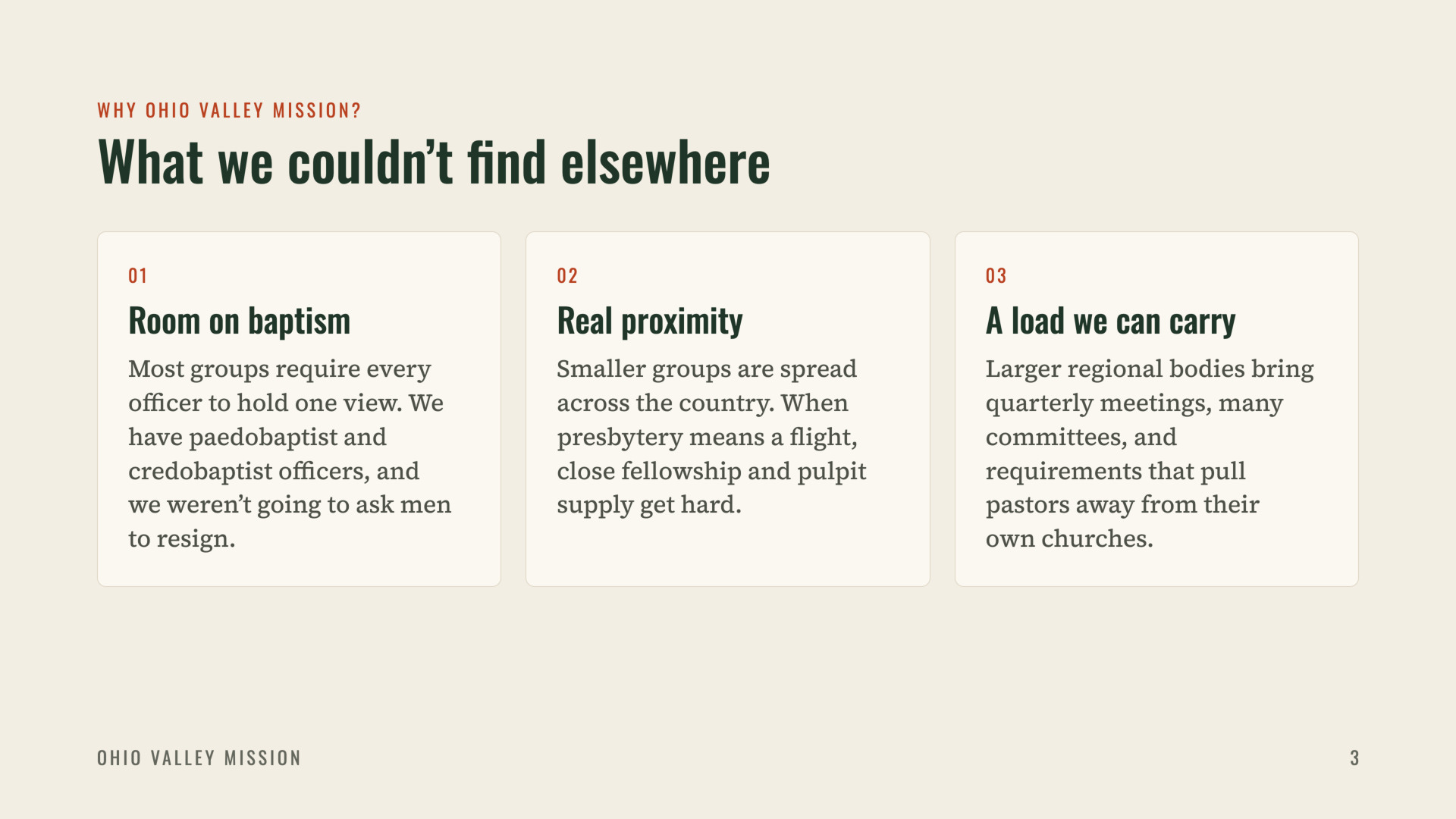
First, we have both paedobaptist and credobaptist officers. Most Reformed denominations require their officers to agree on baptism. Joining one would mean asking qualified, faithful men to resign their offices over a disagreement we’ve already learned to live with.
Second, many smaller Reformed denominations and networks are geographically scattered. They might share our theology, but meaningful fellowship becomes difficult when gathering together requires flights and extended travel.
Third, larger denominations often bring significant administrative demands, committee obligations, and internal controversies. We wanted something that would strengthen our local churches rather than consume the time and energy of their pastors.
We couldn’t be the only church facing these difficulties.
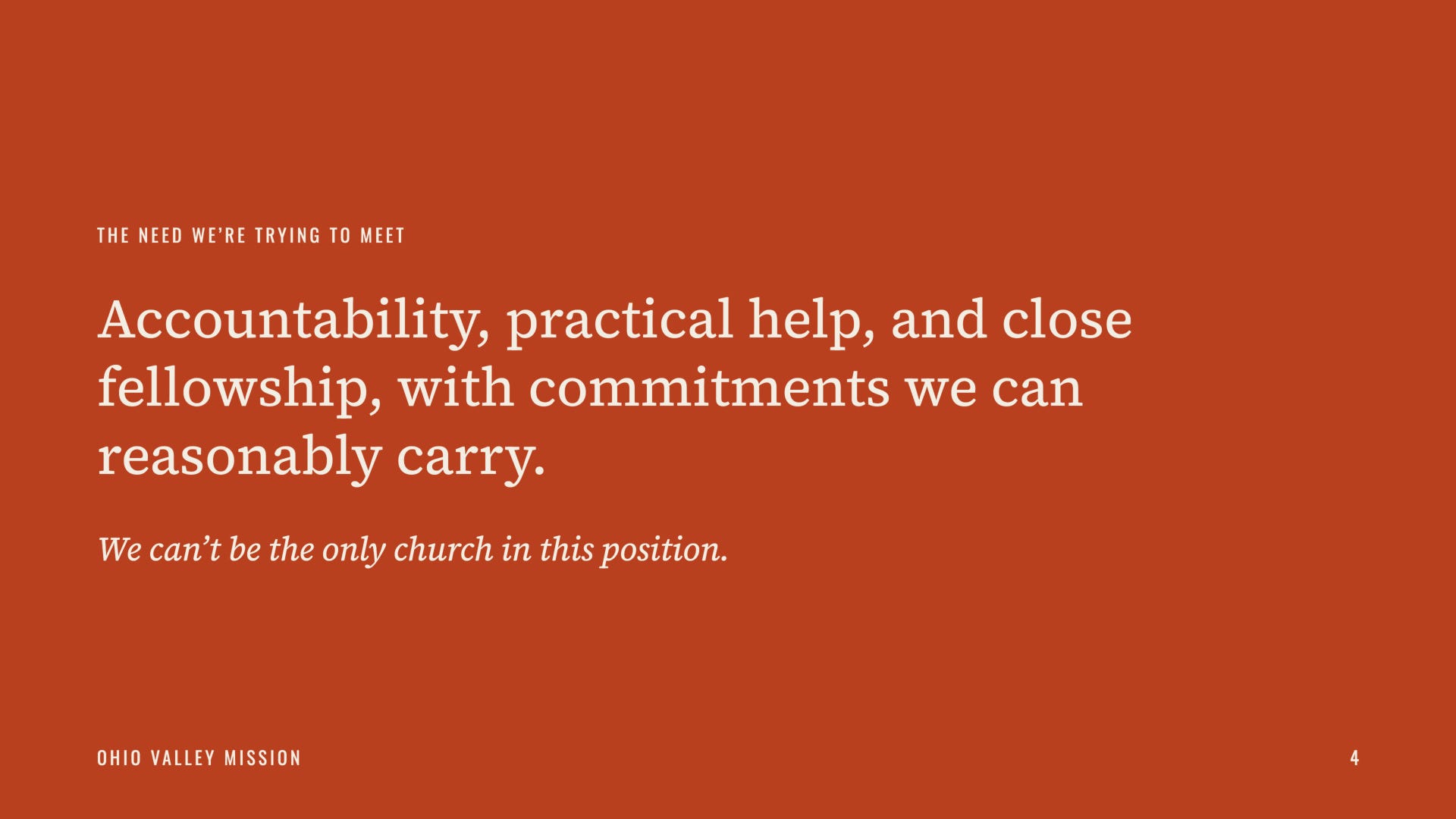
What we wanted was accountability, practical help, and close fellowship, with commitments we could reasonably carry.
That’s the need Ohio Valley Mission exists to meet.
Our Mission: Healthy Churches
Slides 5
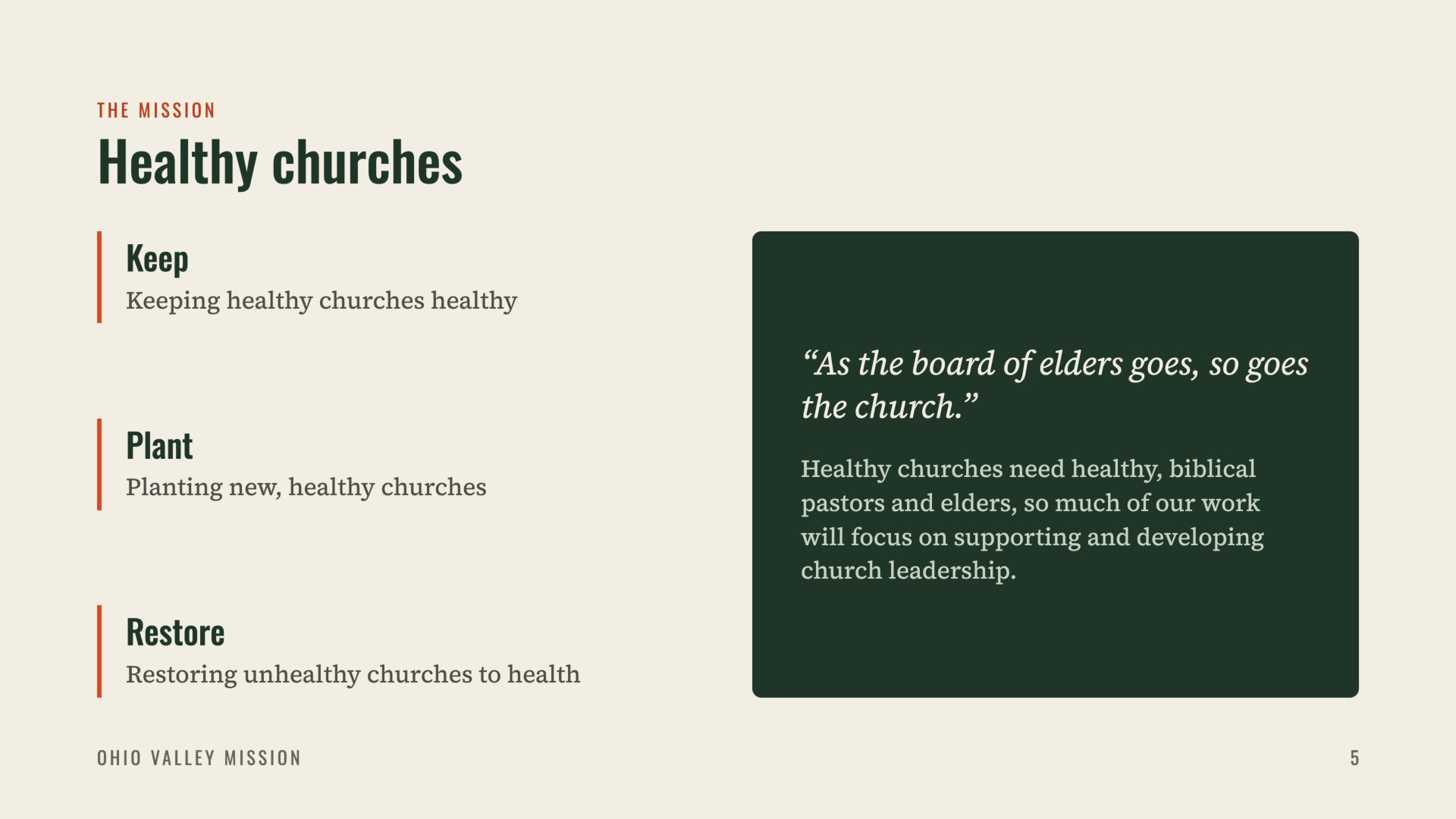
Our mission has three parts: keeping healthy churches healthy, planting new healthy churches, and restoring unhealthy churches to health.
Much of this work begins with church leadership.
I’ve often said that as the man goes, so goes the household. Something similar can be said about the church: as the board of elders goes, so goes the church.
Healthy churches require healthy, biblical pastors and elders. Consequently, much of our work will focus on assessing, developing, supporting, and strengthening church leadership.
What Ohio Valley Mission Is
Slides 6–10
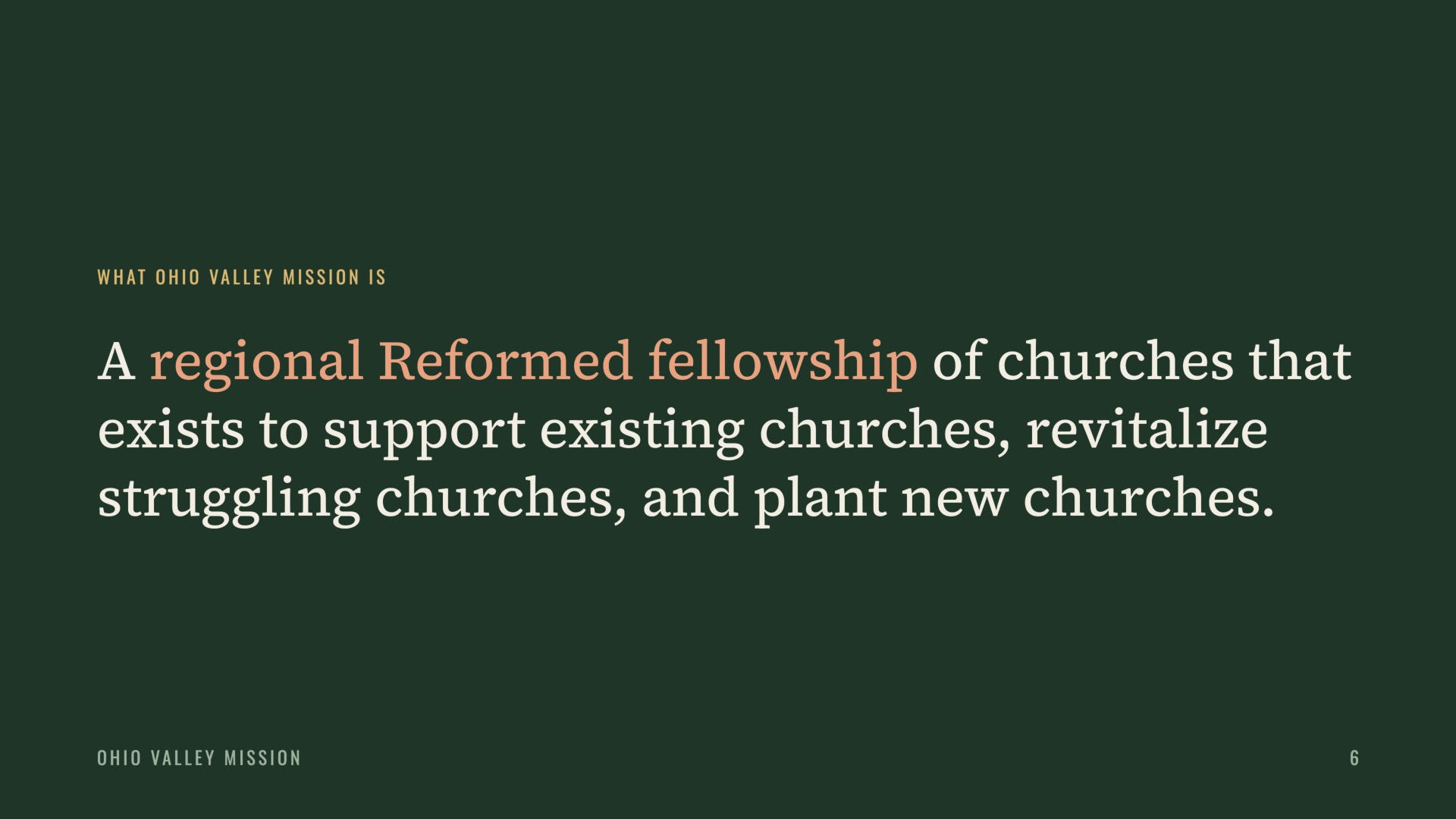
Ohio Valley Mission is a regional Reformed fellowship of churches.
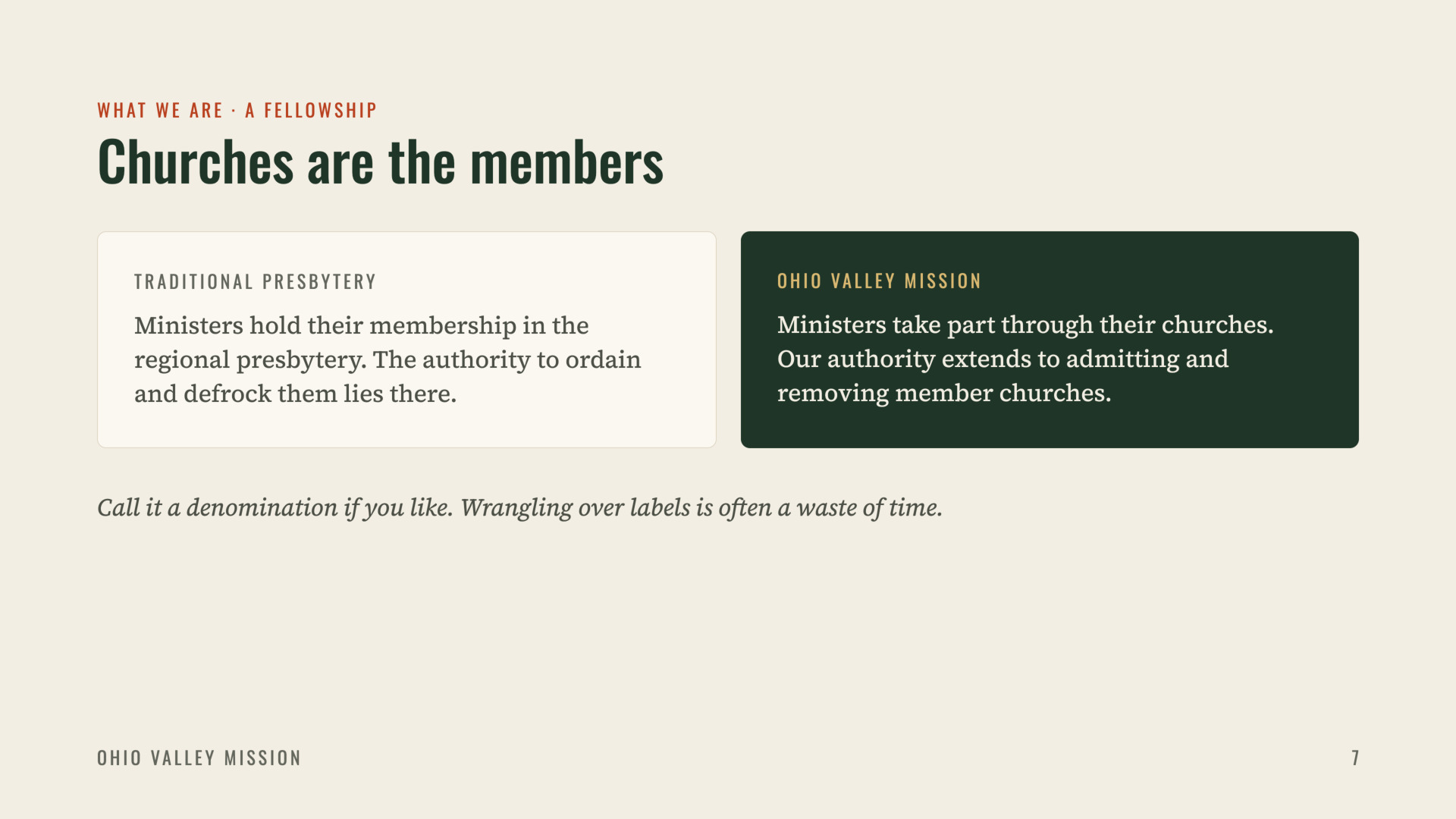
The distinction between a fellowship and a denomination isn’t always clear, and I’m not especially interested in wrangling over terminology. But there is one important difference between our structure and traditional Presbyterian government.
In a traditional presbytery, ministers hold their membership in the presbytery, which possesses the authority to ordain and defrock them. In Ohio Valley Mission, the churches themselves are the members. We do not possess independent authority to ordain or defrock ministers. Our authority extends to admitting and removing member churches.
We’re also intentionally confessional.
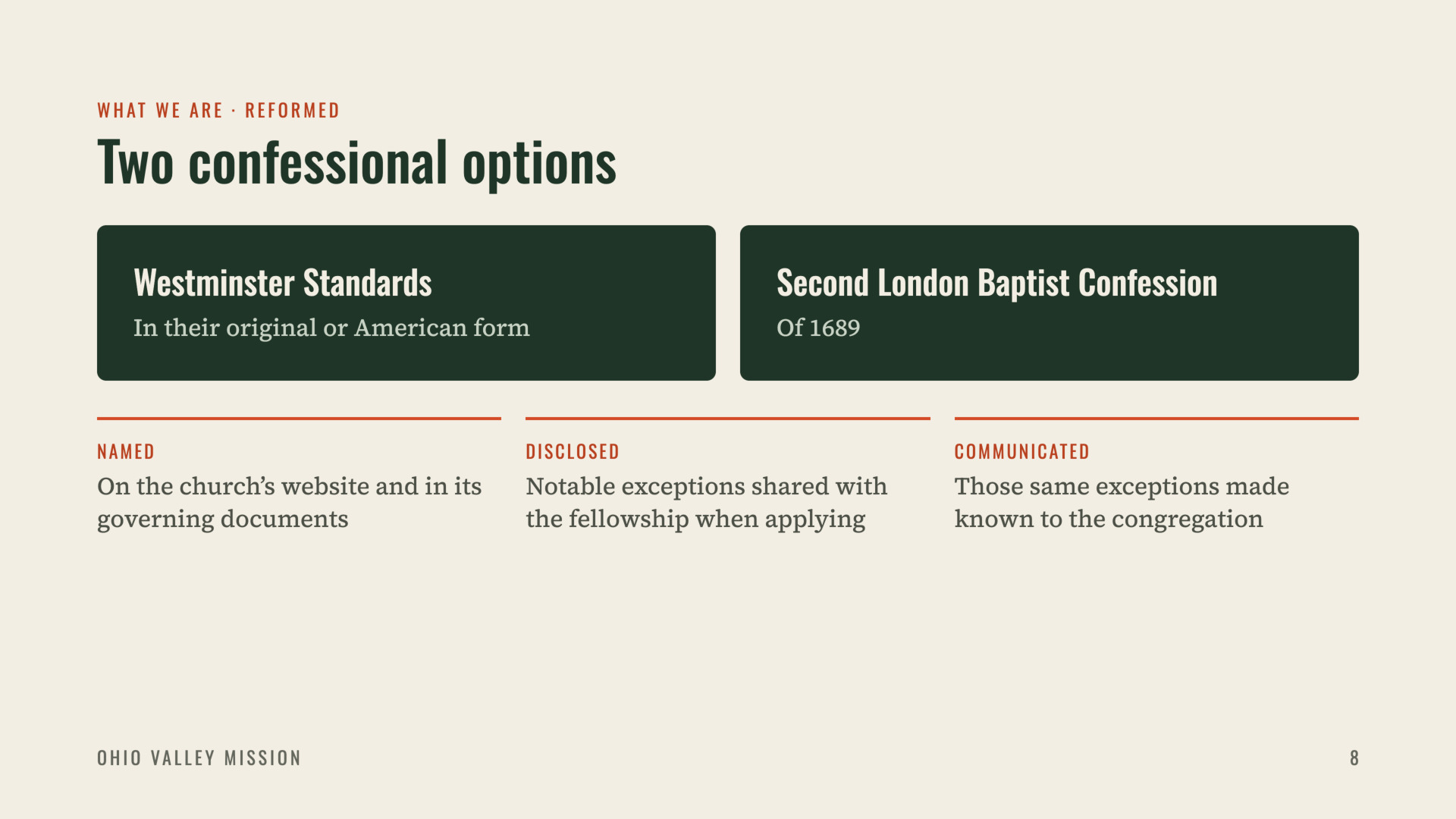
Member churches must subscribe to either the Westminster Standards, in their original or American form, or the Second London Baptist Confession of 1689. Any notable exceptions must be disclosed to the fellowship and communicated to the congregation.
We believe these two confessional traditions share a substantial body of biblical doctrine, even while differing on important matters such as baptism.
We aren’t trying to eliminate those differences. We’re establishing boundaries within which churches can cooperate while maintaining their convictions.
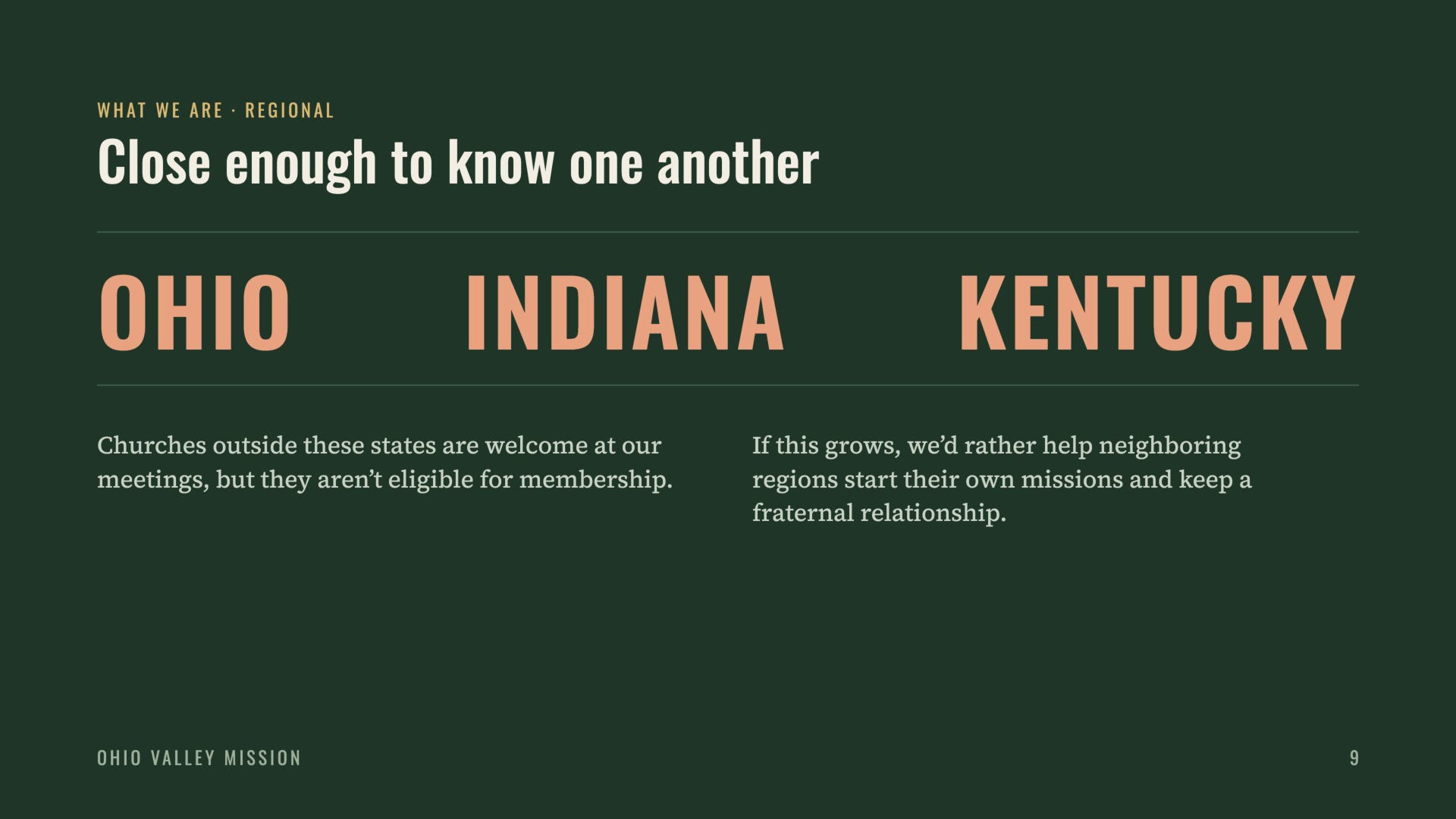
We’re also intentionally regional. Membership is limited to churches in Ohio, Indiana, and Kentucky.
This is not an incidental detail. It’s central to our purpose.
We want pastors who know one another, churches that can readily help one another, and relationships that extend beyond occasional meetings or online conversations. Rather than becoming a nationwide network, we’d prefer to help churches in other regions establish similar fellowships of their own.
Finally, our churches share six commitments: historical biblical Christianity, the centrality of preaching and teaching God’s Word, accessibility to the everyday Christian, addressing contemporary issues, revitalization and church planting, and mutual accountability.
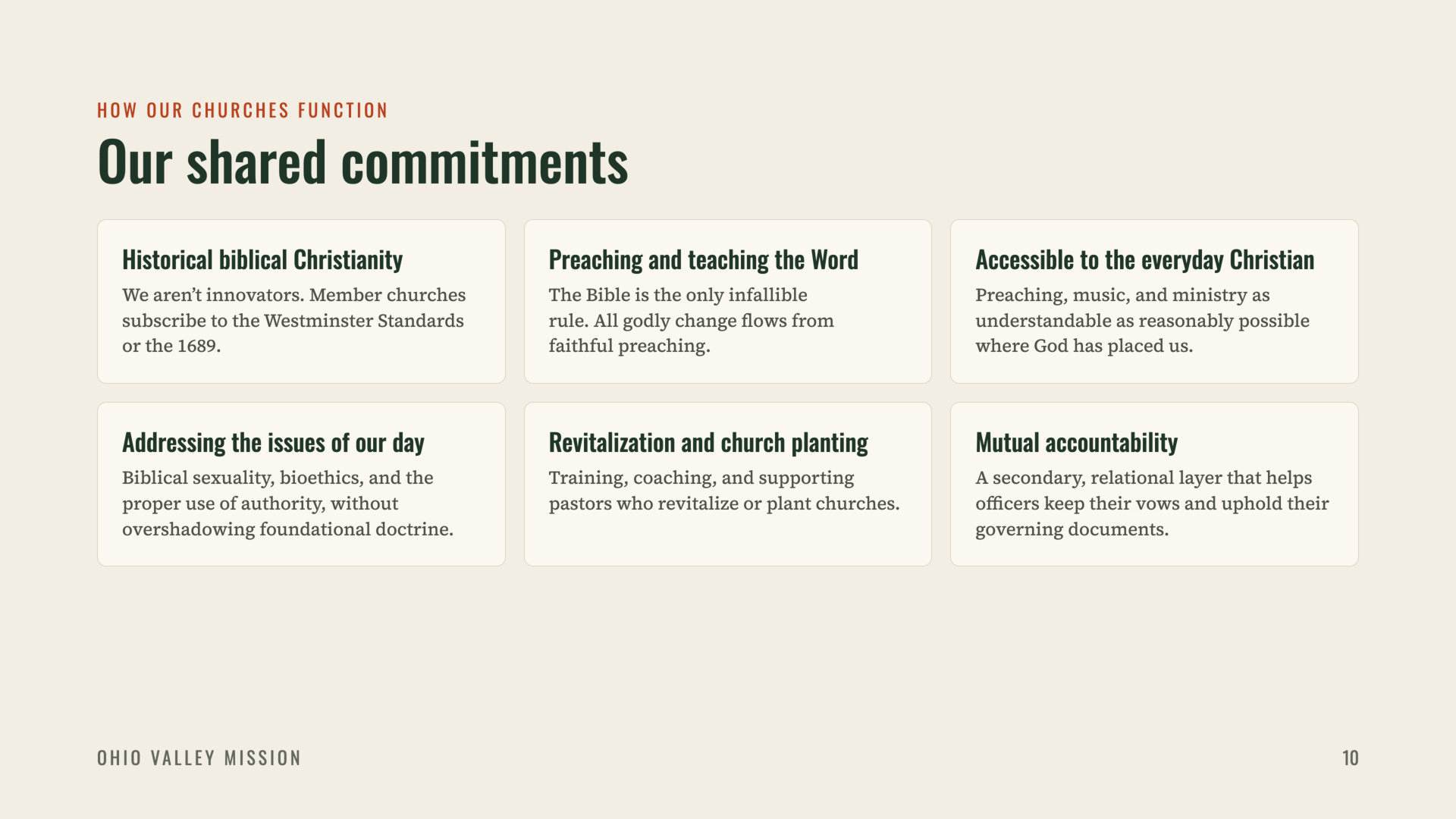
We believe churches should be historically rooted, biblically faithful, understandable to ordinary people, and engaged with the actual challenges of their communities.
Who This Is For
Slide 11
Ohio Valley Mission won’t be for everyone, and that’s fine.
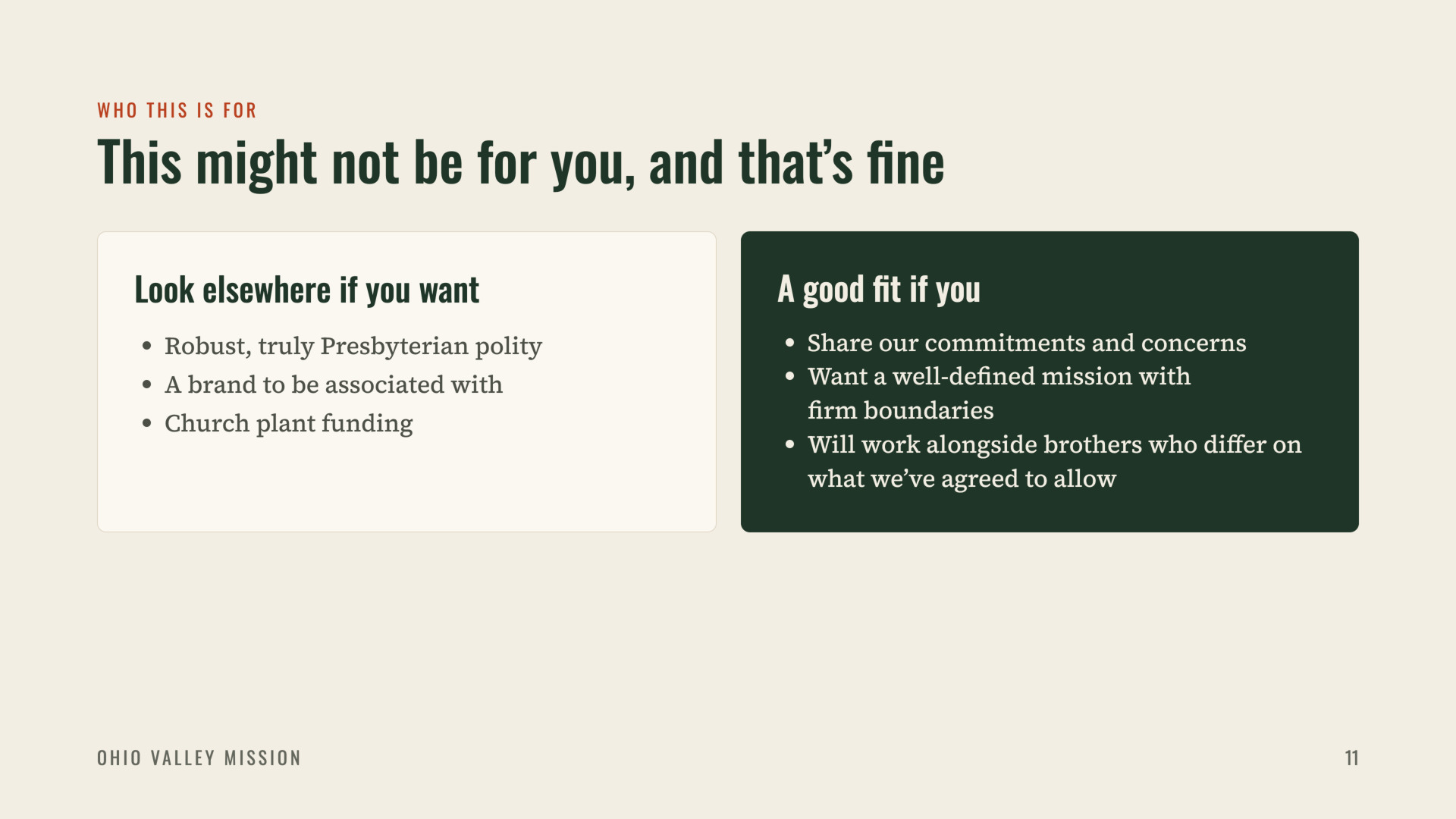
If you’re looking for robust Presbyterian polity, other groups will better serve that purpose. If you’re looking for a recognizable brand or a source of substantial church planting funds, that’s not what we’re building either.
We aren’t trying to meet every need or accommodate every preference. Nor are we particularly interested in competing with other denominations to determine who’s the biggest, most historically authentic, or most impressive.
We have a particular mission with deliberate boundaries.
The right churches for this fellowship will be those that share our commitments, understand our limitations, and genuinely want to work alongside brothers who differ on matters we’ve agreed to allow.
What We Offer: Fraternity, Formation, and Fidelity
Slide 12
We’ve summarized the practical work of Ohio Valley Mission under three headings.
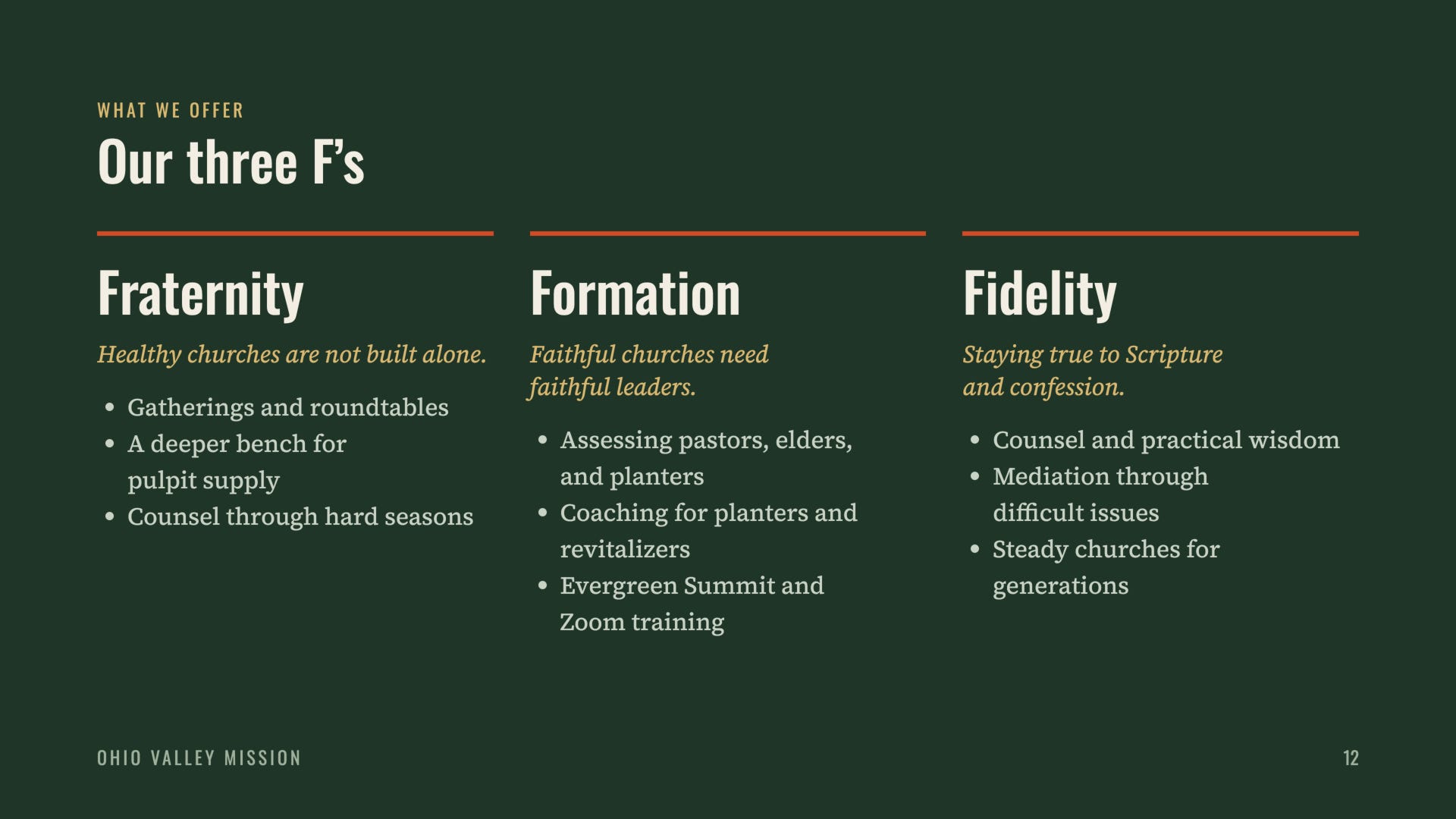
Fraternity. Healthy churches aren’t built alone. We want to cultivate genuine relationships among pastors and elders through regular gatherings, roundtables, pulpit supply, and practical counsel during difficult seasons of ministry.
Formation. Faithful churches need faithful leaders. We’ll help assess prospective pastors, elders, and church planters, provide coaching for men planting or revitalizing churches, and offer ongoing education through the Evergreen Summit and online training.
Fidelity. Churches must remain faithful to Scripture, their confessional commitments, and their own governing documents. We’ll provide counsel and mediation when difficult disputes arise, helping churches preserve their integrity and faithfulness over generations.
Starting Small and Keeping Things Simple
Slides 13–17
One of our guiding principles is to begin with what the business world calls a minimum viable product.
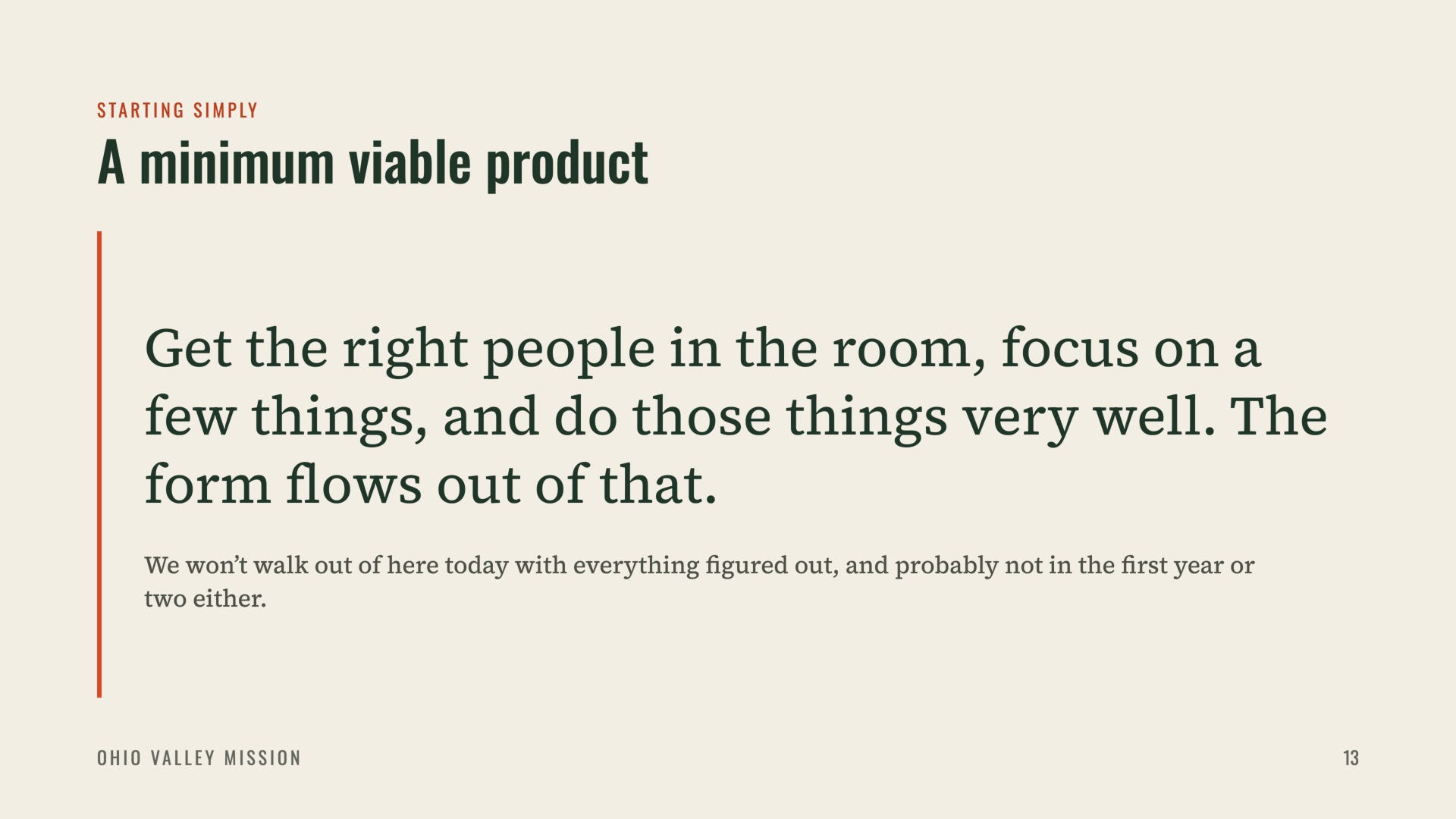
There is a temptation when establishing a new institution to define every detail, construct elaborate systems, and create solutions for problems that haven’t yet arisen.
We’re taking a different approach.
Get the right people in the room, focus on a few things, and do those things very well. The form flows out of that.
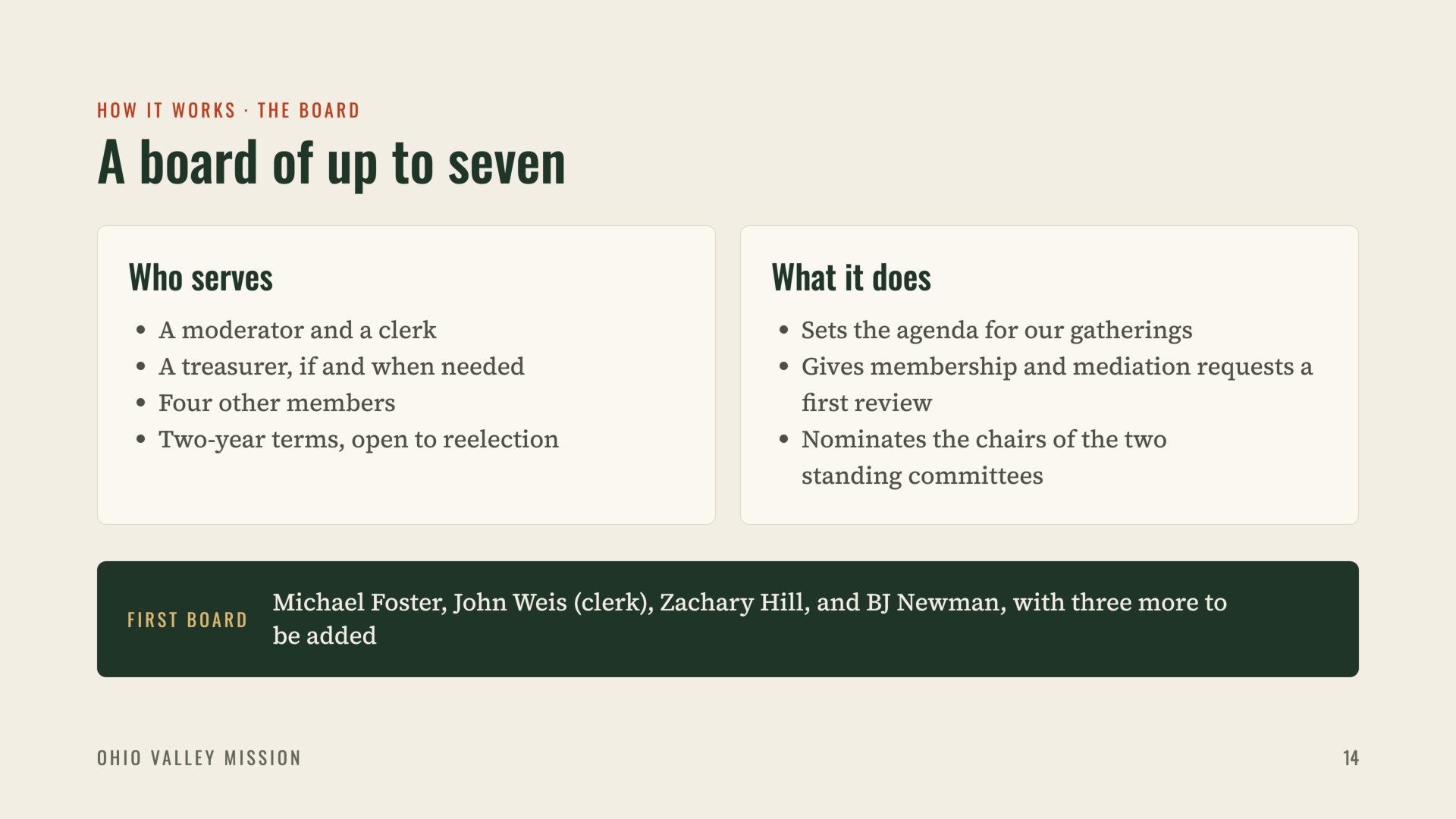
Our initial structure is deliberately modest.
A board of up to seven members will coordinate the mission’s work, establish meeting agendas, and conduct initial reviews of membership and mediation requests.
Two standing committees will handle much of the practical work.
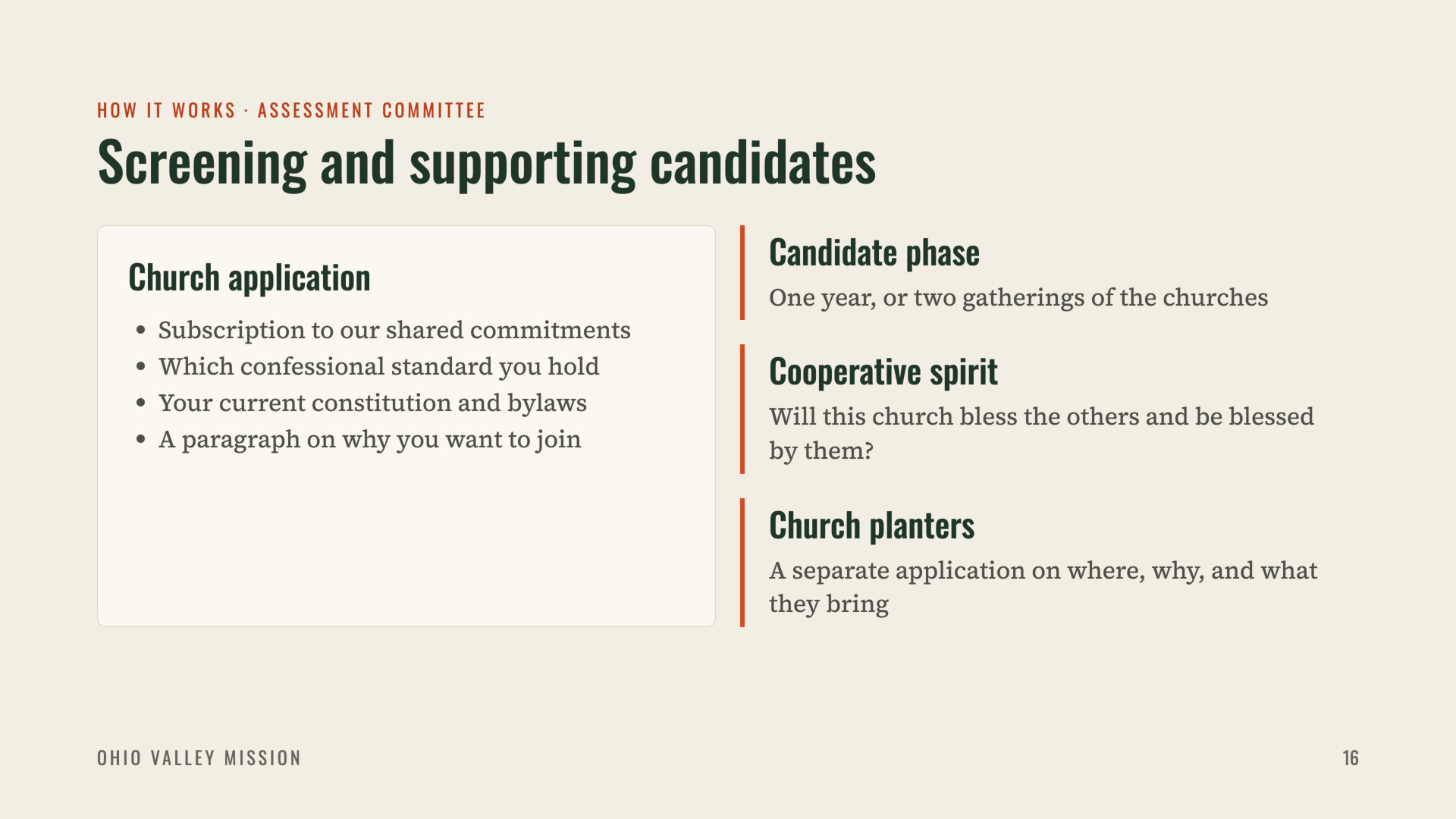
The assessment committee will evaluate churches and church planters seeking membership, considering their doctrine, governing documents, leadership, and willingness to cooperate with other churches.
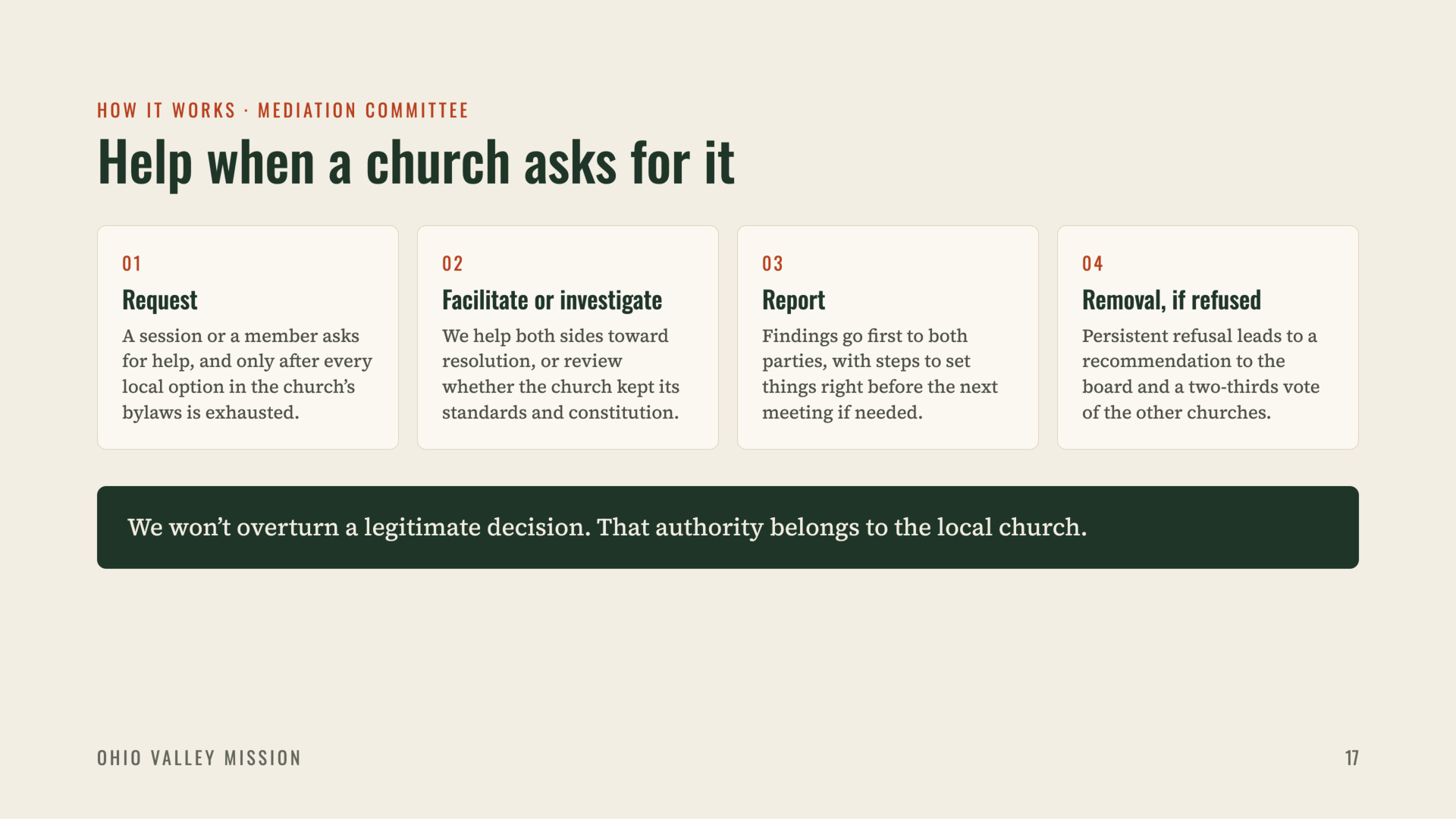
The mediation committee will help resolve serious disputes and investigate claims that a member church has failed to uphold its confessional commitments or governing documents.
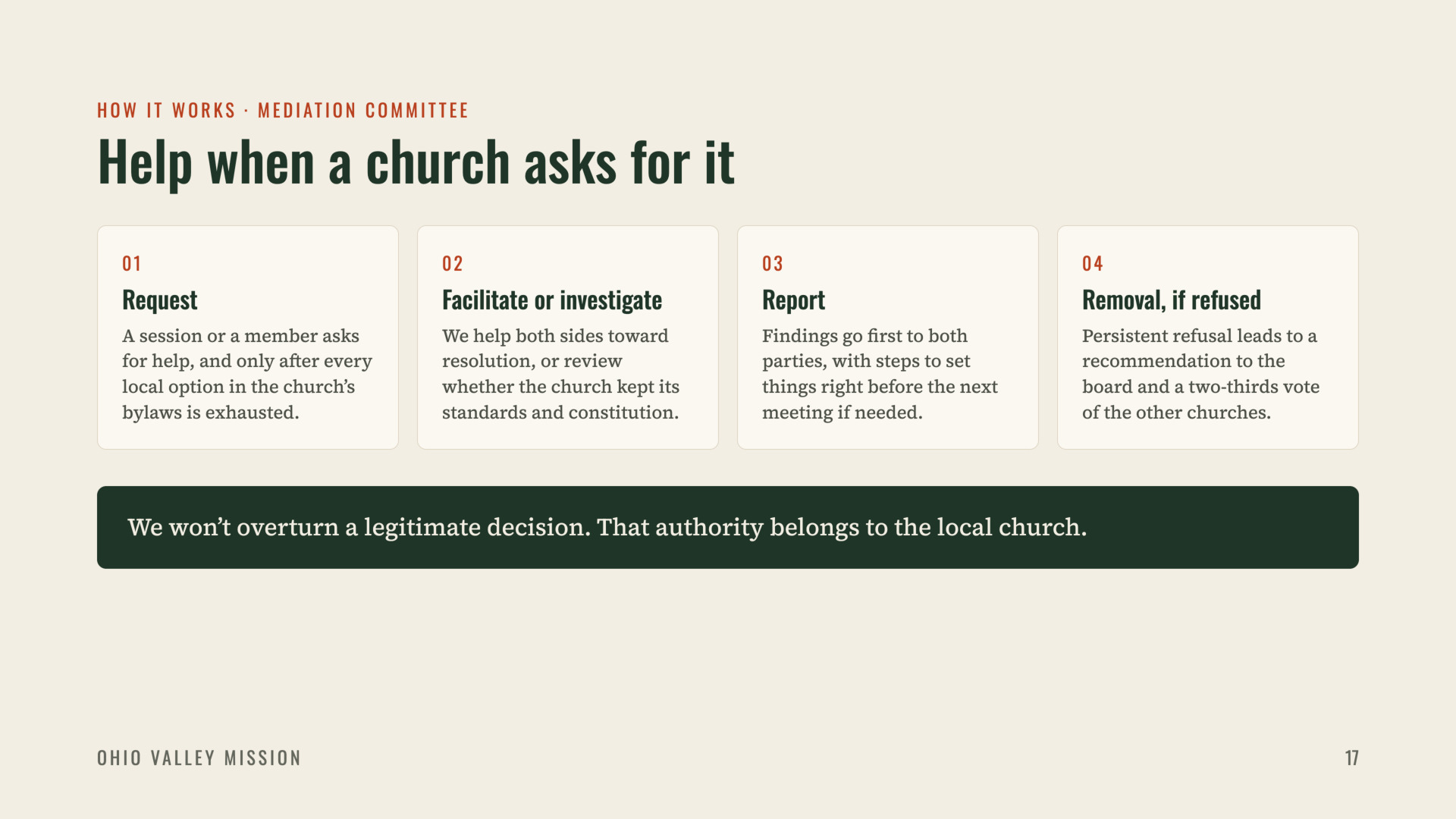
That second responsibility deserves some clarification.
Ohio Valley Mission will not function as an appellate court with authority to reverse legitimate decisions made by local churches. Neither will it insert itself into every dispute between church members and their elders.
Churches retain their authority, and anyone requesting outside intervention must first exhaust the remedies available in the local church’s constitution and bylaws.
When intervention is requested, the committee can investigate, report its findings, and recommend corrective measures where necessary.
If a church persistently refuses to uphold its own governing commitments, it can ultimately be removed from the fellowship by a two-thirds vote of the other member churches.
This provides meaningful accountability without transferring the ordinary government of local churches to a distant bureaucracy.
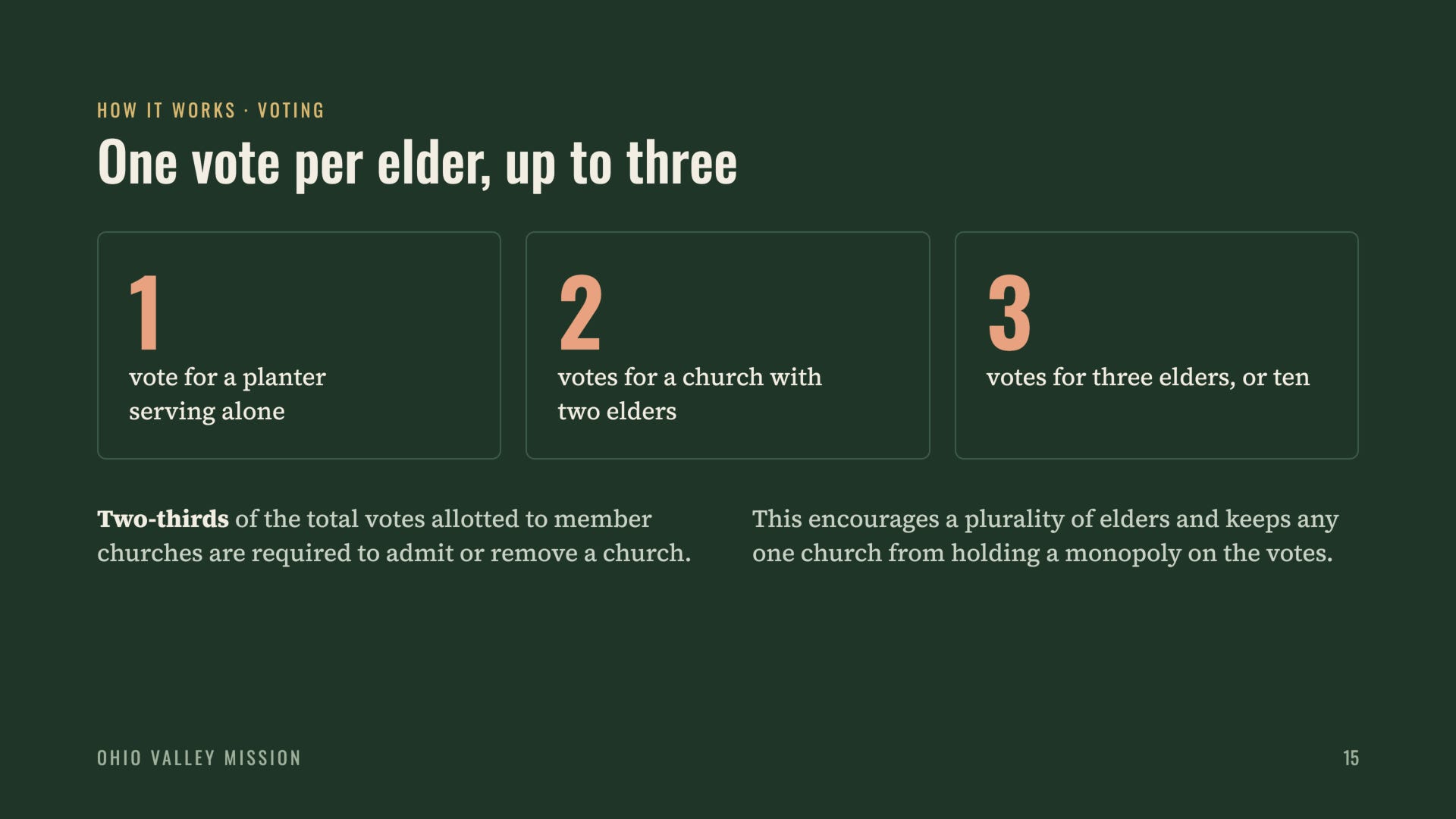
Our voting structure is also simple: one vote per elder, up to a maximum of three votes per church. This encourages a plurality of elders while preventing the largest churches from dominating the fellowship.
Staying Connected and Moving Forward
Slides 18–19
We currently envision two gatherings each year, one in late winter and another in early fall.
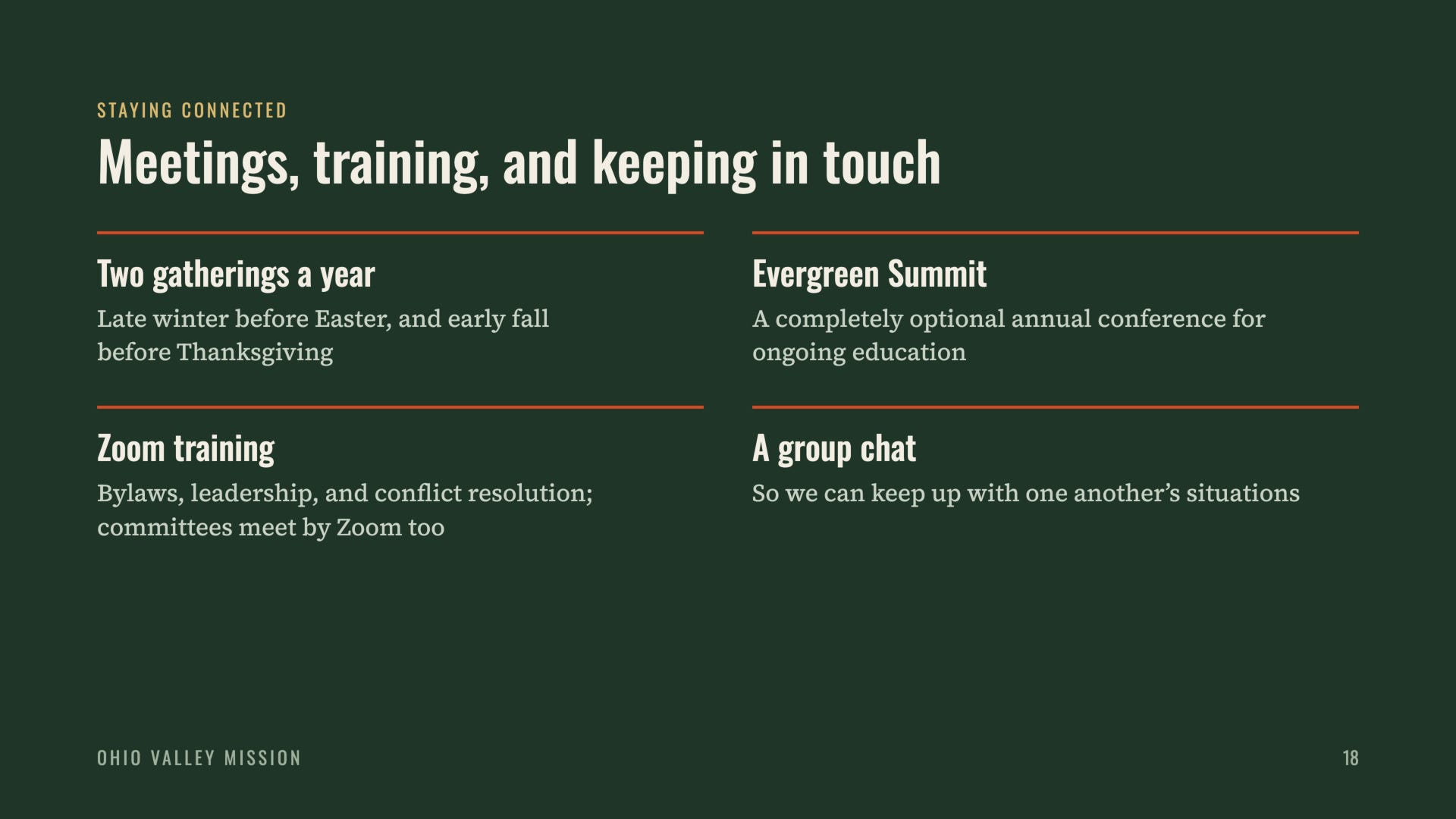
We’ll also offer an optional annual conference, the Evergreen Summit, along with online training in areas such as leadership, church government, and conflict resolution. A group chat will help pastors and elders stay connected between gatherings.
Churches interested in membership will enter a candidate phase lasting one year or two gatherings, during which we can get to know one another, review their governing documents, and determine whether there’s a good fit.
We don’t expect to have everything figured out in the first year or two. That’s part of the point.
We’re starting with a clear mission, a workable structure, and the conviction that healthy churches are worth supporting, planting, and preserving.
We believe that a relatively small fellowship of churches, connected by geography, shared convictions, and genuine relationships, can accomplish a great deal without becoming another enormous ecclesiastical institution.
Make Missions Local Again.
Learn more at ohiovalleymission.org.