

There is a vision I have carried for a long time. I want East River Church to become a sanctuary church. Not in the political sense that word has picked up in recent years, but in a far older and more consequential sense.
The idea came to me when I first studied the early Reformation. The entire continent of Europe was in political and religious upheaval. Rome fought against internal reform, expelled the reformers, and pursued them with political persecution. The result was a great migration. The faithful became exiles, refugees looking for both ecclesiastical and political shelter.
They found it. Cities like Strasbourg, Zurich, and Geneva opened their gates. Under men like Martin Bucer, Ulrich Zwingli, and John Calvin, these cities became more than safe harbors. They became centers of reformational fire. The theology hammered out in those sanctuary cities shaped constitutional government, the dignity of ordinary labor, the foundations of commerce, and much of what we now call the free world. The influence was staggering, and it flowed from a handful of cities that had the courage to be explicitly, institutionally, confessionally Christian.
We are in a recognizable moment. The pressures are different in form but similar in structure. Biblically faithful Christians are increasingly unwelcome in mainstream institutions. The cost of confessional fidelity on sexuality, the family, and the nature of man is rising. A slow exile is underway, not by formal decree but by cultural pressure, professional consequence, and institutional exclusion. Many believers are already looking, consciously or not, for somewhere to land or a way to regain their footing where they already are.
That question is what this essay is about. It is about what it takes to build a sanctuary church, a sanctuary city, and the kind of relational life that makes building possible at all. To answer it well, we need to borrow a framework from an unlikely source, recover an old social model, and synthesize it into something that fits our current reality.
The World We Are Actually Living In
In The Coming of Neo-Feudalism, Joel Kotkin argues that the broad middle-class society built after World War II is collapsing, replaced by a two-tier order where tech oligarchs and a credentialed cultural elite consolidate wealth and power at the top while everyone else slides toward dependency and serfdom. I think he is mostly right about the restructuring of society along these lines. I do think there is a way to reverse or, at least, make the most of the situation while working towards a reversal.
Historically, feudalism was not mainly about kings and castles. It was about layers of loyalty and protection organized around people who controlled land, capital, and force. Most ordinary people lived within the orbit of those local power centers. They were dependent on them and largely unable to exist outside them. That seems be a growing reality that with parallels are hard to ignore.
Power is consolidating into mostly large tech institutions. Amazon, Anthropic, Google, Microsoft. Kotkin writes, “With their tightening control over media content, the tech elite are now situated to exert a cultural predominance that is unprecedented in the modern era. It recalls the cultural influence of the Catholic Church in the Middle Ages, but with more advanced technology.” Indeed. There influences stretches far beyond the digital. They not only control information flow but increasingly shape infrastructure, employment, and political outcomes in ways that no individual, small business, or local government can easily resist. Meanwhile, the traditional sources of middle-class independence are eroding. Small businesses, land ownership, trades, local institutions. More people depend on large centralized systems for income, healthcare, housing, and communication. That dependency looks a great deal like tenancy.
The future will not be uniform. It will be a map of overlapping domains, each shaped by whoever had the foresight to build durable things in that place.
This is the world builders need to think clearly about. And the right framework begins with a barbell.
The Barbell
Nassim Nicholas Taleb developed the barbell strategy in The Black Swan and Antifragile as a way of surviving and thriving in a world defined by uncertainty and hidden fragility.
Picture the barbell itself: heavy weights on both ends with almost nothing in the middle. Taleb argues that your exposure to risk should look exactly like that. Put the majority of your resources into things that are extremely stable. Put a small portion into things with extremely high upside. And ruthlessly avoid the middle zone, the things that feel safe but carry hidden fragility.
His investing example is concrete: 90% in cash or treasuries, 10% in highly speculative bets. Not a diversified moderate-risk portfolio. That middle portfolio looks prudent but hides what Taleb calls tail risk, the rare disaster that wipes you out precisely because you never saw it coming.
The logic is simple. If the safe side holds, you survive any shock. If the risky side hits, the upside is enormous. You protect yourself from ruin while staying open to large gains.
This framework turns out to be a precise map for how builders should structure their relational lives, and for what it takes to plant a sanctuary city in a neo-feudal world.
Builders and Settlers
Before getting to the relational barbell itself, a distinction is worth naming plainly.
In every healthy society, two kinds of people exist. Builders create institutions and economic engines: churches, businesses, schools, landholdings, local networks of trust. Settlers live within those institutions and keep them running. Both roles are legitimate. Both are necessary. But builders shape the future of a place. Settlers inhabit the future builders created.
In a neo-feudal environment this distinction becomes more consequential, not less. The people who matter most locally will be those who build durable things. In medieval societies those people were called barons or lords of the manor, not because they were aristocrats by birth, but because they organized productive life in a place. Everyone else lived within the systems those builders created.
Most people, if you are honest about it, are settlers. They want a manageable plot of land, modest comforts, a stable life, and the quiet satisfactions of ordinary work. That is a dignified calling and, in many cases, this is the ceiling of their personal capacity. Still, God honors the settler. He is the stable weight on the local end of the barbell, and any healthy community depends on him.
But builders are not most people. And if you feel the pull toward something larger, a church that shapes a city, a business that builds generational wealth, a household that produces more than it consumes, you are probably a builder. That is a different calling, and it comes with a different relational logic.
The Baron’s Two Worlds
There is an older model worth thinking about given the high potential of a neofeudal reality.
A medieval baron lived in two relational worlds simultaneously. The tension between them was not a problem to be solved. It was the source of his strength.
His primary life was local. His authority was tied to a specific place: his land, his villages, the people who depended on him. His legitimacy came from being present and responsible. Stewarding land, administering justice, maintaining the web of relationships that made common life possible. His power was not abstract or ideological. It was embedded in a place and among a people.
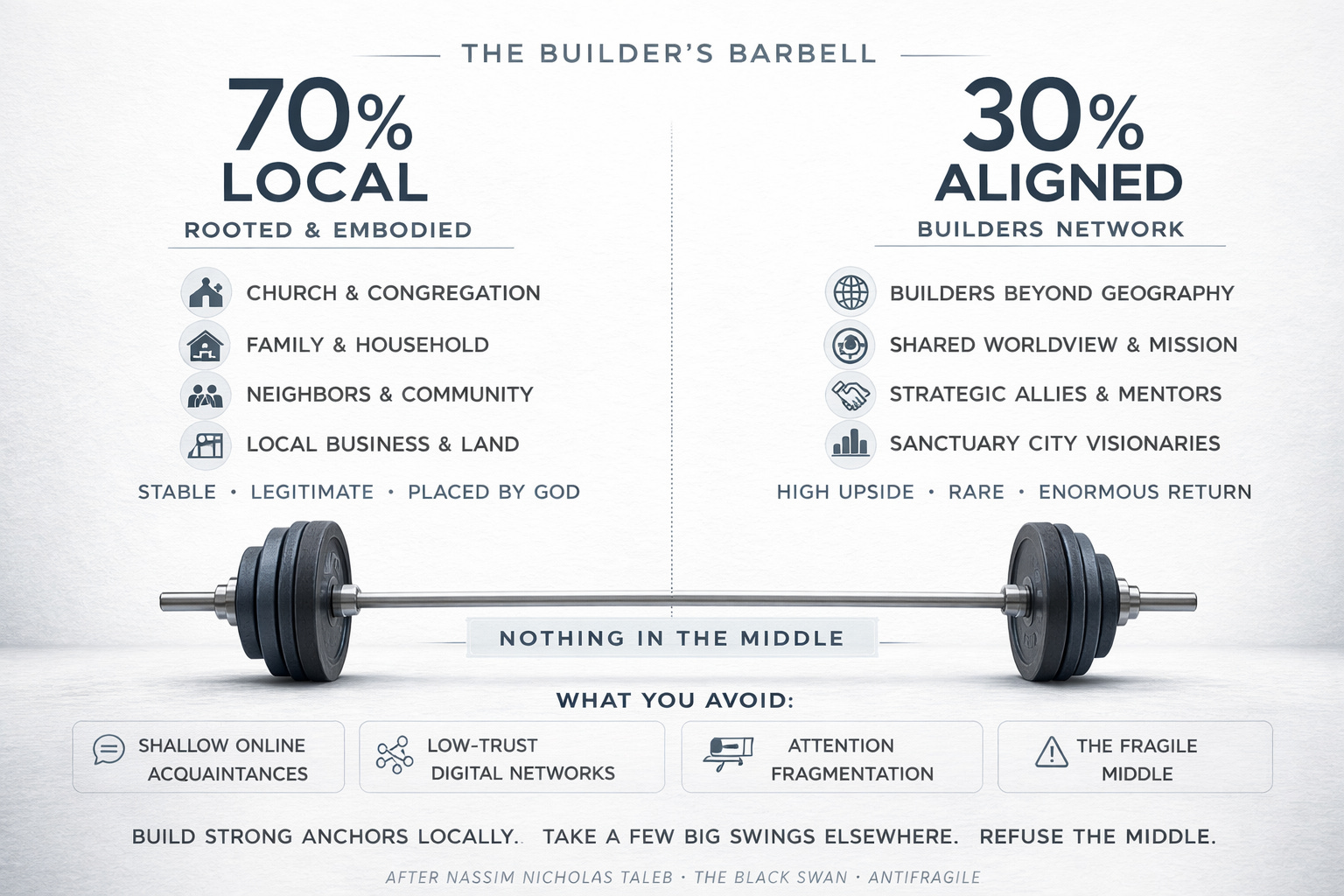
The Christian knows that this is not accidental. God assigns geography. He determines the times and the places where men live (Acts 17:26). You do not choose your city the way you choose a product. You are placed. That placement carries weight and responsibility. Roughly 70% of a builder’s relational life belongs here: church, neighbors, family, local business, local loyalty.
But a baron was not only a local figure. He also belonged to a larger network of aligned nobles under a king or sovereign authority. These relationships were not based on proximity but on shared loyalty, shared vision, and shared mission. A baron might attend royal councils, coordinate with other nobles, fight in national campaigns, and participate in wider alliances. These relationships extended far beyond geography and tied him into a broader order, one that gave his local authority meaning, direction, and protection.
A baron who ignored his land eventually became irrelevant. His peasants stopped trusting him, his fields went unmanaged, his villages looked elsewhere for protection. A man delocated from his place, whether in mind or physical presence, has little to nothing to offer anyone.
A baron who ignored the broader order got eaten. Without allies and without intelligence about what other lords were doing, he was just a local strongman waiting to be outmaneuvered by someone who had done the relational work he hadn’t.
The strength of the system came from holding both at once.
The Problem of Geographic Scarcity
Here is the builder’s practical problem, stated plainly.
Very few people in your geographic proximity share a commitment to biblical sexuality, the productive household, Christian business at scale, or the vision of building sanctuary cities. If you are committed to that vision, you will likely not find ten such people within driving distance. You may find one or two. The rest are scattered, and you need to find them, cultivate those relationships deliberately, and refuse to let geography be the final word on who forms you.
In a neo-feudal landscape this matters more than ever. The emerging domains of influence will be shaped by whoever builds the durable institutions. That requires builders who are connected to one another across geography, sharing intelligence, encouragement, strategy, and accountability. The baron who knew what other barons were doing was more effective in his own domain, not less.
That is the alignment side of the barbell. It is the 30%. These relationships are fewer, less frequent, and higher stakes, and they are capable of enormous return. A single sustained relationship with the right builder in another city may reorient your thinking, open a collaboration, or give language to something you have been carrying for years.
Qualified Localism
This is what I’m starting to call qualified localism. It’s a bit of an evolution from some of my earlier thinking.
Simple localism says your community is everything. Root yourself, serve your neighbors, and let the wider world take care of itself. There is real wisdom here, but taken alone it produces parochialism, a shrinking of imagination and a closing of the mind to what God is doing beyond your county line.
The opposite error says geography is irrelevant. Ideas and networks are what matter. Go where the conversation is. This produces men who are influential online and unaccountable in person. Present everywhere, rooted nowhere. In a neo-feudal world, that is a man without a domain, and therefore a man without lasting power or consequence.
Qualified localism holds both ends of the barbell at once. You are primarily a creature of place, placed by God, responsible to a specific people, anchored in a specific community. That is the 70%. This is the source of your legitimacy. Without it you are not a builder. You are a commentator, as most are these days.
But you are also part of a wider order of builders who share a vision that no single locality can contain. That is the 30%. And what you are avoiding is the weak middle: hundreds of shallow online acquaintances, low-trust networks, constant attention fragmentation across platforms and feeds. Taleb would call that the hidden fragility in your relational portfolio. It looks like connection. It carries tail risk, the slow erosion of depth, accountability, and real influence that you never see coming until it is already gone.
Build strong anchors locally. Take a few big swings elsewhere. Refuse the middle.
The Sanctuary City
The Reformation did not spread through a centralized campaign. It spread through cities.
When Rome moved against the reformers, expelling them and hunting them across political borders, certain cities opened their gates. Strasbourg under Bucer. Zurich under Zwingli. Geneva under Calvin. These were not merely tolerant places. They became centers of gravity, cities where the Reformed faith was not just permitted but institutionally embedded, intellectually sharpened, and sent back out into the world.
The exiles who flooded into those cities weren’t simply refugees. They were builders looking for a base. Geneva became a training ground. Pastors trained there went to France, Scotland, England, and the Netherlands. The theology hammered out in those cities shaped constitutional government, the dignity of ordinary labor, and the foundations of commerce. Western civilization as we know it has a return address, and it is a handful of cities willing to be explicitly, confessionally Christian.
We need such cities again. They begin with sanctuary churches: congregations committed to the central doctrines of Scripture, willing to speak directly to the issues of the day, and actively equipping believers to be agents of reformation in every sector of society. Churches that don’t merely shelter the faithful but form and deploy them.
From that church, over time, you get the other pieces. Christian-owned businesses. Schools that form children rather than process them. Households that produce more than they consume. Local political involvement that is neither naive nor cynical. A community dense enough to absorb newcomers, anchor the wavering, and project influence outward.
A sanctuary city is a base as opposed to a compound. The Reformation sanctuary cities worked because they held both ends of the barbell at once: intensely local, rooted in a specific city and congregation, and connected to a wider network of reformers sharing theology, strategy, and personnel. The local and the aligned worked together, and the result was a movement that reshaped the world.
The Neo-Manorial Vision
There is a positive vision underneath all of this.
The emerging neo-feudal landscape is an invitation as much as it is a threat. If centralized institutions are becoming the new lords of the manor, then the answer is not to complain about them. It is to build competing centers of gravity.
The medieval manor was the basic unit of civilization. Not a castle. A working estate: a church, a mill, a market, craftsmen, farmers, and a lord accountable to the people under his protection. It was local, productive, and self-reinforcing. Life happened there. What we need is not nostalgia for that world but the underlying logic of it. Durable local institutions. Strong households. Real accountability to real people.
That is the neo-manorial vision. Churches that anchor a community. Businesses that build generational wealth. Schools that form children rather than process them. Households that produce more than they consume. Land held and stewarded across generations.
But no manor stood alone. The barons knew each other. They shared intelligence, forged alliances, and reinforced one another’s work across geography. The same logic applies now. The most important development of the next generation may not be any single sanctuary city. It may be the network connecting them. Builders in Clermont County who know builders in Bozeman, Greenville, and the Panhandle. Men and women working their own ground, staying in contact, and learning from one another. That network already exists in fragments. It needs to be named, strengthened, and extended.
That is the work I intend to spend my life on. A sanctuary church at the center of a sanctuary city. Seventy percent rooted, thirty percent aligned, nothing wasted in the fragile middle.
The baron model shows it has been done before. The Reformation shows what it can produce. The barbell shows how to structure the relational life that makes it possible.
My views are still evolving and maturing. My general advice remains roughly the same. Find a place. Build something durable. Stay connected to others who are. Refuse the fragile middle. If God has entrusted you with baron-like resources or influence, work towards that 70/30 builder’s barbell.
Thank you for putting into words what I’ve had rattling around in my head lately!
In the spirit of this article; please DM me if you’re reading this and are within a couple hours of Madison, WI. Would love to connect with aspiring neo-feudalists.